LINE: Disney Tsum Tsum
- 3.9
- Rating
- 10.00M
- Installs
- Free
- Price

 Analysis by App-foxy
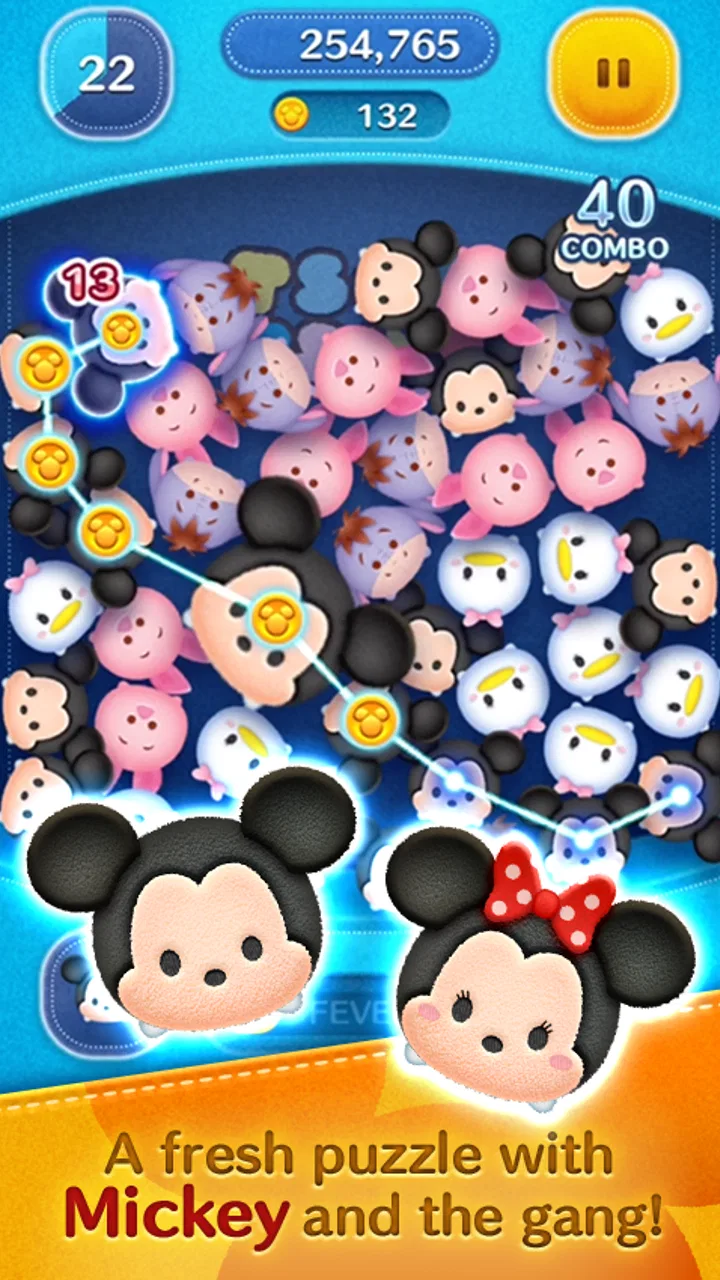
I keep coming back to LINE: Disney Tsum Tsum for the same reason I return to a good pocket puzzle: it is easy to understand in a few seconds, but it leaves room to improve long after the basic rules feel familiar. The screen fills with soft, rounded Disney characters, and I connect matching Tsum Tsum by tracing through them before the short round ends. It feels light, cheerful, and immediately playable, yet each round also asks me to make quick decisions about space, timing, and which chain is worth taking.
This is a free puzzle game from LINE, the company now known as LY Corporation, and it has been available since June 30, 2014. Its age rating is Everyone, so it is approachable for families and younger players, while the fast pace still gives adults a satisfying little challenge. The game has passed 10 million installs and holds an average rating of 3.9 from around 545,000 ratings, which matches my impression: it is broadly appealing, though not completely free of friction.
How a normal round feels in practice
The baseline workflow is wonderfully simple. I start a round, scan the board for connected characters, drag across a group, and release to clear it. The cleared pieces disappear, new ones fall into place, and I repeat the process until the timer runs out. That short loop makes the game useful in small gaps during the day. I can play one round while waiting for a coffee, take a break between tasks, or settle into a longer session when I want to chase a better result.
You May Also Like

 Blood Strike: 2.5 Anniversary
Blood Strike’s Loadouts Turn Every Drop Into a Tactical Gamble
A close look at Blood Strike’s custom loadouts: how fast access to signature weapons reshapes its battle royale rhythm, rewards preparation, and narrows the gap between fights.

 Pandora - Music & Podcasts
Pandora’s Music Is Easy to Start, but Harder to Recover
Pandora’s strength is its low-effort path from a seed to a station. Its weak spot is how much confidence it asks you to place in connection, setup, and quiet recovery.

 8 Ball Pool
 Is Built on Rivalries, Rematches, and Routine
A close look at the rivalries, rematches, shared routines, and unanswered safety questions that turn a quick pool match into a persistent mobile community.

 Samsung Music
’s Quiet Strength Is Playing What You Already Own
Its reach comes less from spectacle than from dependable access to a personal library. That simplicity is both the app’s strongest retention engine and its ceiling.

 AccuWeather: Weather Radar
AccuWeather Review: A Quick, Clear Forecast for Everyday Decisions
For everyday plans, the best forecast is the one you can understand quickly. AccuWeather makes rain timing, radar, and local conditions easy to act on, with a few trade-offs.

 Hill Climb Racing
Why Hill Climb Racing Still Turns Crashes Into One More Run
A tiny car, a bumpy hill and one more upgrade: Hill Climb Racing keeps resurfacing because its simple chaos makes every near-miss feel personal.
More From Our News Desk
View All News


The important detail is that I do not need a long tutorial to understand the first few rounds. The board communicates almost everything through movement and animation. Matching is visual, the action is performed with one finger, and the consequences of a move appear immediately. That makes the game a good choice for someone who wants a puzzle that can be learned without reading a rulebook.
At first, I naturally clear the longest chain I can see. That works well enough for learning, but it is not always the smartest move. A slightly shorter chain may open the middle of the board, create better follow-up options, or prevent the remaining Tsum Tsum from becoming awkwardly scattered. I found that the game becomes more interesting when I stop treating every move as an isolated match and start considering what the next two moves might look like.
That change in thinking is the real beginning of mastery. I now look for a useful chain, but I also check whether clearing it will leave a crowded corner or split the board into disconnected pockets. A long chain is satisfying, yet a clean board often produces a better rhythm. This is one of the reasons the game has lasted on my phone: the rules stay friendly while the decision-making gradually becomes more deliberate.
A realistic everyday session might look like this: I have five minutes before an appointment, so I play without trying to optimize every action. I focus on keeping my hand moving and clearing obvious groups. Later, when I have more time, I pay attention to the board’s shape and try to improve my consistency. The same game supports both moods without forcing me into a complicated setup.
What I check before chasing better results
The settings and surrounding menus are worth checking before settling into regular play. I prefer to review sound and notification behavior early, especially if I plan to play in public or during quiet breaks. Puzzle games often feel harmless until repeated effects become distracting, and adjusting the experience to match the situation makes a noticeable difference. I also make sure the game is comfortable to control on my device before judging my performance.
That last point matters more than it sounds. Because rounds depend on quick tracing, finger placement and screen response can affect how confident I feel. If my hand covers too much of the board, I slow down. If I play while holding the phone awkwardly, I make more accidental movements. I get better results by using a relaxed grip and keeping the display clear rather than by simply trying to swipe faster.
I also recommend spending a little time learning the visual language of the board. The characters are cute, but the decoration should not become the only thing I notice. I look for clusters, open paths, and areas where a clear may cause useful pieces to fall. Once I recognize those patterns, I spend less time hesitating. The improvement comes from faster reading, not from turning the game into a stressful reflex test.
Players should also understand the free-to-play structure before becoming invested. The game costs nothing to download, but it includes optional in-app purchases ranging from $1.99 to $49.99 per item. I can enjoy the core puzzle without paying, but the presence of purchasable items means I would set a personal spending boundary before exploring every available menu. That is especially sensible for a family device.
I would not treat purchases as a replacement for learning the board. The biggest gains in my play come from recognizing good chains and managing the limited round time, not from tapping through menus. Someone who wants a completely purchase-free environment may prefer a paid puzzle game with no optional spending, while someone comfortable with a free download and optional extras will find the arrangement familiar.
Small habits that make the board easier to read
My first useful habit is to avoid staring at one promising chain for too long. I scan the whole board, identify two or three possibilities, and then choose the one that leaves the best follow-up. This prevents me from wasting the opening moments on a move that looks impressive but creates no momentum. It also helps when the board changes quickly after a clear.
My second habit is to keep the tracing motion controlled. I do not need to draw a perfect geometric line, but I do need to stay aware of where the chain is going. A rushed swipe can skip a useful character or send me toward a less convenient route. Smooth movement is more reliable than frantic movement, particularly when I am trying to extend a chain through a crowded area.
My third habit is to use the edges deliberately. Pieces near the outside can be easy to ignore because the center attracts attention, but clearing an edge group may give the rest of the board more room to reorganize. Conversely, I sometimes leave a small edge cluster alone if it is not blocking anything and a central move offers a stronger continuation. The point is not to follow a rigid rule; it is to judge whether a clear improves the next view.
I also learned not to restart mentally after one poor move. A messy opening does not automatically ruin a round. The falling pieces can create a better arrangement, and a calm second decision is often more valuable than trying to compensate with reckless speed. This makes the game less frustrating and gives casual players a practical way to improve without turning every attempt into a test.
For longer sessions, I like to alternate between a relaxed round and a focused round. In the relaxed attempt, I observe how the board behaves and avoid worrying about the result. In the focused attempt, I apply one specific goal, such as scanning before moving or keeping my chains smoother. This approach gives me something concrete to practice and avoids the vague feeling that I should simply “play faster.”
Where experienced play becomes faster
Experienced play is less about one magical shortcut and more about repeatable timing. I try to decide while the board is still settling rather than waiting for every piece to become perfectly still. That does not mean moving blindly. It means using the brief transition to prepare my eyes for the next choice, so I am ready when the new arrangement becomes clear.
I also prioritize continuity. If two possible chains are similar, I choose the one that keeps my hand near the next likely group. This reduces unnecessary travel across the screen and helps maintain a steady rhythm. The difference is small in one move, but over a full round it makes the game feel less stop-and-start.
Another useful pattern is to avoid clearing every obvious group immediately. Sometimes a small matching group is better left in place because it helps connect a larger chain after the board shifts. I do not hold pieces indefinitely, since hesitation costs time, but I give myself a brief moment to ask whether the easy move is actually useful. That question is more valuable than blindly hunting for the longest visible line.
When I am practicing, I watch for the point at which my decisions become automatic. If I can identify a chain without losing awareness of the surrounding board, I am improving. If I am only reacting to the nearest group, I am probably playing quickly but not intelligently. The game rewards a balance between speed and planning, and that balance is different for every player.
The Disney theme also affects how the game feels compared with more abstract puzzle alternatives. A minimalist match game may offer a cleaner competitive presentation, while a traditional tile puzzle may provide slower, more methodical planning. This one sits between those experiences: the rules are immediately accessible, the presentation is character-driven, and the short rounds encourage repeated attempts. I would choose it over a quiet logic puzzle when I want energy and personality, but not when I want a deep, uninterrupted problem that can occupy me for an hour.
Limits that become clearer with regular use
The same fast structure that makes the game convenient can become repetitive. The basic action remains familiar, so players who need constant mechanical novelty may eventually feel that they are repeating the same gesture. I enjoy improving my choices, but I understand why someone looking for a wide variety of puzzle formats might move to a larger collection of different challenges.
The short timer can also divide players. I find it motivating because it gives each round a clear shape, but it leaves little room for slow contemplation. If you prefer to examine every possibility before committing, this is not the ideal puzzle. A turn-based or untimed alternative would be more comfortable for careful planners who dislike pressure.
Touch control is another practical limitation. On a small phone, tracing through a crowded board can feel less precise than on a larger display. Players with larger fingers or reduced dexterity may need more patience, and the game does not transform into a relaxed tap-only experience just because the rules are simple. I would try a few rounds on the intended device before deciding whether it feels comfortable.
The free model may also influence how some people approach the game. I appreciate being able to start without an upfront payment, but optional purchases can make the surrounding experience feel less clean than a single-purchase puzzle. Anyone who is easily tempted by collectible or progression-related spending should decide in advance how they want to use the game. For children, I would be especially careful about device purchase controls and supervision.
Compatibility is straightforward for many users: the current version is 12.9.1 and requires Android 8.0 or later. That makes checking the phone’s operating system a sensible step before installing, particularly on an older device. The game is also available in the broader Android and iOS ecosystem, so it is a practical recommendation for households using different mobile platforms, although the exact feel will still depend on each screen and device.
Who will enjoy it, and who should choose something else?
I recommend this game to Disney fans who want a puzzle they can pick up immediately, to commuters who prefer short sessions, and to families looking for an approachable mobile activity. It is also a good fit for players who enjoy improving through repetition. The rules are simple enough for a newcomer, while the board-reading habits give experienced users something meaningful to refine.
I would be more cautious recommending it to someone who dislikes timed play, character-themed presentation, or free games with optional purchases. It is also not my first choice for a person seeking a pure logic challenge with no visual clutter and no pressure to act quickly. In those cases, a slower tile puzzle or a paid minimalist game may be a better match.
My practical advice is to install it for the short-round convenience rather than expecting a full-scale puzzle campaign. Play with a relaxed grip, scan before tracing, and judge moves by what they create next, not only by how long the current chain looks. If you enjoy that small improvement loop, the game can become a pleasant daily habit. If the timer feels irritating after a handful of attempts, no amount of character appeal will change the basic design.
After regular play, my view is positive but measured. The strongest part is the balance between instant accessibility and room for better habits. I can hand it to a new player and explain the action almost immediately, yet I can still notice a difference when I improve my scanning, timing, and board management. That is a valuable quality in a mobile puzzle, especially one designed for brief sessions.
The current version keeps the game relevant for modern Android users, and its long presence helps explain why the format remains recognizable. Still, its age is visible in the repetition and in the free-to-play boundaries. I would not call it the most sophisticated puzzle on a phone, but sophistication is not really its purpose. It aims to make a quick round feel cheerful, responsive, and just competitive enough to invite another try.
In the end, I see LINE: Disney Tsum Tsum as a dependable choice for light puzzle entertainment, especially when I want something familiar that rewards small improvements. I would start with the free experience, check the settings, decide on a spending limit, and give the scanning habits time to develop. If that routine sounds enjoyable, it is easy to recommend; if you want quiet, untimed, or constantly changing puzzles, I would point you elsewhere.
FAQs for LINE: Disney Tsum Tsum
01What is LINE: Disney Tsum Tsum and how is it played?
LINE: Disney Tsum Tsum is a casual puzzle game based on small, collectible Disney and Pixar characters called Tsum Tsum. The main objective is to connect three or more matching characters by drawing a line across them before the timer runs out. Clearing longer chains creates special effects, fills skills, and helps you achieve higher scores during each short, fast-paced round.
02Is LINE: Disney Tsum Tsum free to download and play?
Yes, LINE: Disney Tsum Tsum is generally free to download and play on supported Android and iOS devices. However, it includes optional in-app purchases for items such as premium currency, boosters, or additional gameplay resources. You can make progress without paying, but purchases may help you obtain certain characters or recover resources more quickly. Check your device’s purchase settings before playing.
03Does the game require an internet connection or a LINE account?
An internet connection is normally required for downloading updates, accessing events, synchronizing progress, and using online features. The game may also connect with a LINE account or another supported login method, depending on your region and device. Linking an account can help protect your progress, especially when changing phones, but availability and requirements may vary between countries.
04Are there many Disney and Pixar characters to collect?
Collecting characters is one of the main attractions of LINE: Disney Tsum Tsum. The game features numerous versions of familiar Disney and Pixar characters, and many have unique skills that affect gameplay in different ways. New or limited-time Tsums may appear through events and special boxes, so the available collection can change regularly. Some characters can be difficult to obtain.
05Is LINE: Disney Tsum Tsum suitable for children?
The game is easy to understand and uses colorful Disney-themed visuals, making it accessible to many younger players. Nevertheless, parents should be aware of timed gameplay, online connectivity, advertising or promotional content, and optional in-app purchases. Some characters and rewards are obtained through chance-based boxes, so parental controls and purchase restrictions are recommended when children use the app.
Pros
- Simple tap-and-swipe controls make matches easy to learn.
- Disney character collection gives the game strong nostalgic appeal.
- Short rounds fit well into quick breaks or commutes.
- Regular events and missions provide fresh short-term goals.
- Works well for casual players who prefer relaxed puzzle gameplay.
Cons
- Energy limits can interrupt play during longer sessions.
- Random capsule rewards may make collecting favorite Tsum Tsum difficult.
- Some upgrades and premium items can become expensive over time.
- The screen can feel crowded when many effects appear at once.
- Progress may feel repetitive after mastering the main gameplay loop.

LINE: Disney Tsum Tsum
Gallery